A toddler with a bucket of sand is solving more engineering problems than most college freshmen on their first day of lab. Why STEM at this age is a way of being, not a subject.
A toddler with a bucket of sand is solving more engineering problems than most college freshmen on their first day of lab.
This is meant as a compliment to the toddler.
The current marketing of STEM education has done early childhood a quiet disservice. It has convinced a generation of parents that science, technology, engineering, and mathematics are content categories — facts to memorise, kits to assemble, screens to swipe. They are not. At the age of two, three, four, five, STEM is not a subject. It is a way of being in the world. And the world, conveniently, is everywhere a child is.
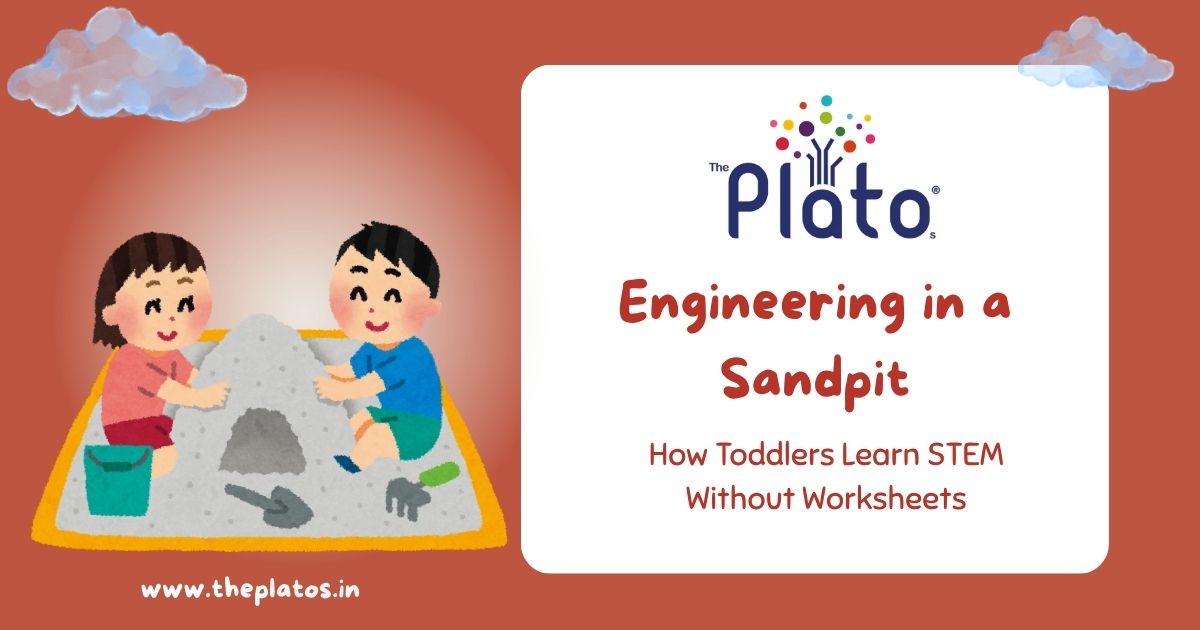
A child digging in a sandpit is doing, in this order: testing the structural properties of a granular material, observing how moisture affects compression, refining a hypothesis ("if I pat it harder, it will hold"), iterating after a failure ("the tower fell because the base was too narrow"), and constructing a working model. Most adults could not articulate this if pressed. The child certainly cannot. But the brain is doing it anyway, at a depth and pace that no worksheet will ever come close to.
Block towers are the same. So are mud cakes. So is the half-hour a four-year-old will spend pouring water from one cup to another, an activity adults find tedious and children find clarifying. She is calibrating volume. She is observing conservation. She is discovering that a tall thin glass and a short fat one can hold the same amount of water — a concept that takes some six-year-olds an entire formal lesson to grasp. The toddler is just figuring it out herself, slowly, without anyone telling her she is doing it.
Sorting is mathematics. A child arranging her toys by colour, then size, then shape is doing classification, which is the foundation of every later mathematical operation. Counting fruit at the kitchen counter is mathematics. Comparing the height of two siblings is mathematics. The simple, repeated activities of a household are quietly some of the richest mathematical environments a young brain will ever encounter.
This is what our STEM Way is built around. We do use age-appropriate digital tools — augmented reality, interactive screens, simple gears and pulleys — because we want children to understand that technology is something they can shape, not just something that is handed to them. But we are very careful about the order. Real things first. Hands first. Bodies first. The screen, when it comes, comes as a continuation of curiosity that has already been built in three dimensions.
This is also why we are sceptical of worksheets at this age. A worksheet asks a child to remember. A sandpit asks a child to discover. Both have their place — but at three and four, the second is overwhelmingly the more important one. A child who has been allowed to discover for herself for a few thousand hours arrives at formal schooling with the strange and useful conviction that learning is something she does, not something done to her. That is a difficult conviction to install later. It is a much easier one to never lose.
If you are a parent and the words STEM make you nervous, please relax. You are not behind. You are not failing your child by not buying a coding kit. The most important things you can do for early STEM development cost nothing. A pile of blocks. A bucket of water. A patch of dirt. A few measuring cups in the kitchen. An ant your child wants to follow for ten minutes — and the patience, on your part, to let her.
There is no shortcut, but there is also no rush. The brain has its own schedule. Our job, as adults, is to clear the path and stay out of the way.
A toddler with a bucket of sand is doing real engineering. Not because she is a prodigy, but because she is a child, and children, when allowed, are some of the most committed scientists you will ever meet.
We have built our school around the idea that this is enough. That it is, in fact, the right beginning. The worksheets can wait.